
Today another semester began at Bethany Lutheran College, where I teach courses in American history. I began History of the U.S.A., 1877-Present with a quotation from the memoirs of Richard M. Nixon, composed, by the way, before his election to the presidency and the Watergate scandal. So please give him a fair hearing (from Six Crises [1962], 296–97):
History, literature, philosophy, and the classics—taught by inspirational men—is the best foundation for a career in politics. There will be plenty of time later to learn firsthand the intricacies of political strategy and tactics by working in the precincts. There will be too little time later for gaining indispensable knowledge in depth about the nature of man and the institutions he has created—an understanding which, from my experience, can better be acquired from the classics than from the more ‘practical’ courses in politics. ...
The college years—when the mind is quicker, more receptive, and more retentive than it will ever be again—can best be used to develop the whole man rather than the specialist. ... If a man comes out of college with only the narrow and thin background of the highly trained political specialist, he may win elections—but he will serve neither his country nor himself as well as he should. He will be a sitting duck for every half-baked idea or time-worn cliché that comes along. ...
The public man must not only know what the law is: he must know how and why it got that way. And again, the time to acquire this background is during the college and university years when a man has the time to indulge in the luxury of reading and thinking. Later on, he may well find himself too busy acting and speaking; and if he does not acquire this perspective and background in his college years he may never acquire it.
Nixon rightly understood the liberal arts tradition. "Liberal" comes from libertas, Latin for "liberty," or what our Saxon heritage preserved as Freiheit, "freedom." In Roman civilization, the alternative to liberty was servitude, slavery. A liberal arts education prepared a person to cultivate the life of free citizenship, and to preserve it for future generations.
Today, things are much the same. (Human nature never really changes that much.) A college education might get you a higher-paying job. A higher-paying job might empower you to buy more stuff. But to realize your full humanity requires something different than the accumulation of stuff. As Nixon explained (Six Crises, 432–33):
Material advancements, while necessary, do not meet the deeper needs of mankind. Man needs the higher freedoms, freedom to know, to debate freely, to write and express his views.
He needs the freedom that law and justice guarantees to every individual so that neither privilege nor power may make any man subservient before the law.
He wants the freedom to travel and to learn from other peoples and cultures.
He wants the freedom of worship.
To us, these are the most precious aspects of our civilization.
Ah, the college years. A time to read. A time to think. A time to ponder. A time to prepare to become the custodians of liberty for future generations.
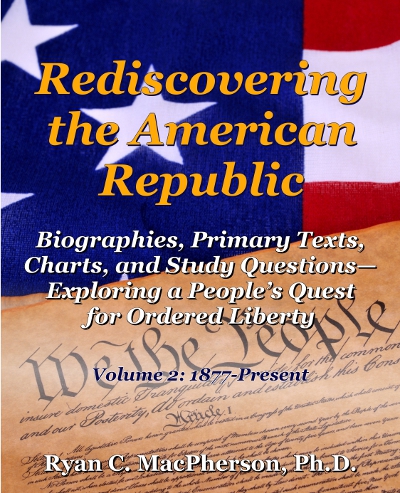
Dr. Ryan MacPherson holds a PhD in history and philosophy of science from the University of Notre Dame. After serving for twenty years as a professor at Bethany Lutheran College, he served as the founding academic dean of Luther Classical College for three years. He is author of Rediscovering the American Republic, a two-volume anthology of primary sources in American history, as well as several other books on topics ranging from theology to politics to bioethics. Dr. MacPherson has testified in court in defense of a homeschool father and for the protection of traditional American civics curricula, contributed to legal briefs submitted to the U.S. Supreme Court in defense of marriage and the rule of law, appeared regularly on a variety of radio shows, and taught seminars for pastors and educators in Canada, Denmark, and Ecuador. The MacPherson homeschool family offers online enrichment courses through Lifelong Lyceum.
